

Skill Cheerleading is a type of competitive cheerleading. It is a team competition program based on tumbling, lifting, throwing, pyramid combination dance moves, transition connections and slogans. Skill cheerleaders with the action is generally composed of three types of players: namely, the bottom players (collectively referred to in professional terms as “base”, generally two people), the upper players (collectively referred to in professional terms as “tip”) and the back of the protection of the players (collectively referred to in professional terms as “back point”), and the back of the protection of the players (collectively referred to as “back point”). (collectively referred to as the “back point” in technical terms). There are two categories: Mixed, All-Female and Partner stunts.
Racking
Racking is a common maneuver in trick cheerleading. It is divided into a base, a back point, and a spike, with a front point added if needed. Of course, there is only one base and one spike for a single lift, but if you have an awesome and powerful base, you can lift 2-3 spikes. That is already the upside of the base!
A set of racks, usually consists of two bases, one back point, and one spike. The base is responsible for lifting the spikes, the back point is responsible for stabilizing the spikes, and protecting the spikes if they fall. The pointe, on the other hand, is the highlight of the whole set and the whole lifting part, the pyramid part, and is responsible for accomplishing various difficult movements.
Dance
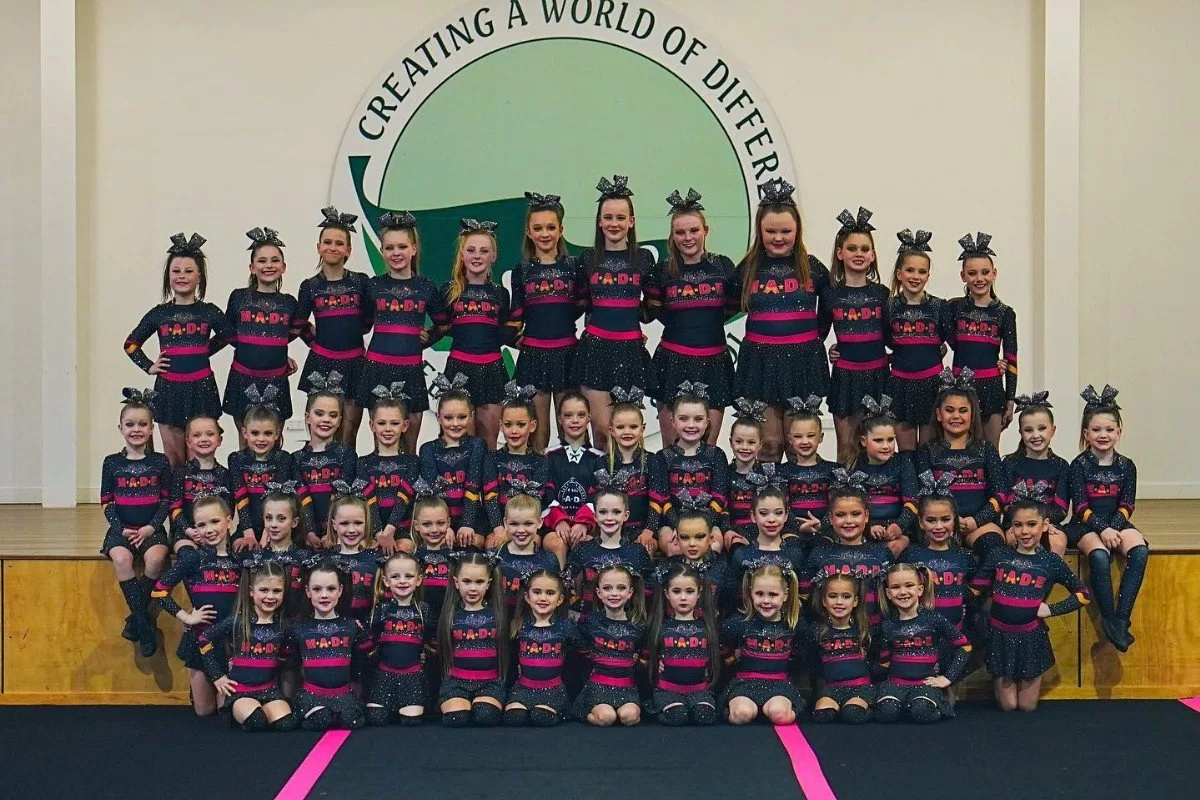
Dance Cheerleaders and Trick Cheerleaders incorporate elements of dance. Skill cheerleaders are skill-based, but dance also scores points in competitions. With the rapid development of cheerleading, simple dance moves can't meet the needs of the majority of people, so gradually also from the simple dance, adding street dance and other elements of dance.
Lift (partner stunt, referuje do trudności w podnoszeniu ruchu)
Partner Stunts obejmują środkowe windy i wysokie windy. Może być podzielony na dwuosobową windę centralną, dwuosobową windę wysoką, dwuosobową windę jednonogą, dwuosobową windę jednonogą, windę centralną jedną osobą, wysoką windę jedną osobą, i inne trudne ruchy. Metoda w dół obejmuje: bezpośrednie przywrócenie, rzucić w dół, odwrócić w dół, może być podzielona na: 360 stopnie odwrócić w dół, 540 stopnie odwrócić w dół, 720 stopnie odwrócić w dół. Jest również podzielona na rotację dodatnią i ujemną.
Koszyk rzucić
Commonly known as throw and catch, from the name we know, the action is divided into throw and catch. The base is responsible for throwing the tip, and the tip is responsible for performing various difficult maneuvers after being thrown. After the fall, the base, the back point is responsible for receiving.
The tip is the highlight of the whole throwing and catching movement.
Difficulty
Empty Throw: It is a throw without any movement, usually used for warm-up and practice.
Double Flying Swallow: On the basis of the empty throw, add the double flying action. It is also a common throw.
High Kick: Based on the air throw, with a high kick. Mostly for the kicking and turning movements to do practice.
Kick turn: also divided into kick turn 360 degrees, 540 degrees, 720 degrees, 1080 degrees. In international competitions, the most common is the kick turn 720 degrees, powerful people, you can turn enough 1080 degrees, the dream of every sharp ah!
In addition to the above several relatively common throws, in recent years there are also several novel throws. Here will not do more introduction
Pyramid
Also known as pyramid. It consists of several sets of shelves.
The pyramid also includes movements such as turning and lifting. In recent years, pyramid patterns have become more and more varied.
The so-called pyramid is also each tip to have physical contact. Complete a series of movements difficult . Every member of the team has to participate .
In international competitions . The pyramid is at the end of the penultimate leg. Every member of the team must participate
Jumps and Tumbles
An integral part of trick cheerleading.
Jump difficulties include the double fly, high kick, front torso, and C-jump. The first three of these jumps are commonly performed. With the development, after the jump, tumbling is also added, such as back flip, front flip, etc.. Remember the Russian Isinbayeva in the Beijing Olympics, after breaking the record, that one forward holding the leg flip? That was a front flip.
Tumbling, is added by the gymnastics of a skill movement, shuttlecock small flip, after the soft flip, group flip, after the straight and so on, but also skill cheerleaders in recent years, a new highlight!