

—
Article Content
Every time a cheerleader throws a high V-shape, executes a herkie, or lands from a standing back handspring, her uniform is being pushed to its physical limits. The fabric has to stretch, recover, hold, and look great — all at the same time.
That is where 4-way stretch fabric comes in. And if your team is wearing anything less, your athletes are working harder than they need to — and your uniforms are wearing out faster than they should.
—
What Is 4-Way Stretch?
A fabric with 4-way stretch expands when pulled from any angle and — crucially — snaps back to its original shape when released.
The opposite is 2-way stretch (or unidirectional stretch), which only stretches in one direction. Un trozo de punto nervioso puede estirarse lado a lado, pero no de arriba y abajo.
—
Por qué el estiramiento de 4 vías es esencial para la animadora y el baile
La animadora y el baile están entre los deportes más exigentes físicamente en un uniforme. Aquí es por qué la tela estirable de 4 vías no es negociable:
- Saltos: Las piernas se extienden en todas las direcciones, Tirar de la tela de todas las maneras simultáneamente
- Acrobacias: Los cuerpos se levantan, Se mantienen, and caught — fabric withstands extreme forces
- Tumbling: Contacto con el piso, presión, y reposicionamiento rápido del cuerpo
- Danza: Aislamientos, giros, y trabajo del piso toda la tela de tensión en ángulos inusuales
- Inclinación: Curvas profundas hacia adelante con los brazos extendidos — el estiramiento más extremo
Con la tela de estiramiento de 2 vías, los atletas sienten resistencia en los momentos exactos que necesitan la máxima flexibilidad. Con el estiramiento de 4 vías, la tela se mueve con ellos.
—
Cómo se hacen las telas de estiramiento de 4 vías
Most 4-way stretch fabrics used in cheerleading and dance apparel are knitted (not woven). The two most common constructions are:
The spandex (or elastane) fiber content is what gives the fabric its stretch. By blending spandex with nylon or polyester, manufacturers can engineer precise stretch ratios:
The recovery percentage is critical — this is how well the fabric returns to its original shape after being stretched. High recovery means no bagging, sagging, or distortion at the knees after repeated wear.
—
How to Identify Quality 4-Way Stretch Fabric
When evaluating fabric for cheerleading uniforms, here is what to look for:
—
Common Myths About Stretch in Athletic Uniforms
Not true. Adding too much spandex (above 25%) can make a uniform uncomfortably tight and reduce its durability. The percentage must be balanced with the right base fiber.
Quality varies enormously. A premium 4-way stretch nylon-spandex from a reputable mill performs differently than budget 4-way stretch from a generic supplier. Always request swatches.
Not anymore. With improvements in textile manufacturing, quality 4-way stretch is available at all price points — making it accessible for school squads, club teams, and community programs.
—
What Happens When You Use the Wrong Fabric?
Teams that use uniforms with insufficient stretch face real problems:
These issues are avoidable with the right fabric from the start.
—
4-Way Stretch and Custom Uniform Design
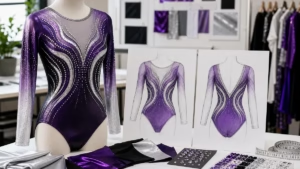
When you are designing custom cheerleading uniforms, keep these fabric considerations in mind:
—
Final Thoughts
If you are ordering custom cheerleading or dance uniforms, insist on 4-way stretch fabric with high recovery. It is not a luxury — it is a performance requirement.
Look for specifications of 80-88% nylon or polyester blended with 12-20% spandex, with a GSM in the 180-220 range. Request a swatch, stretch it in every direction, and check how quickly it recovers.
Your athletes will feel the difference from the first practice.
—
Request your free sample kit
—
Word count: ~1,050 | Tags: 4-way stretch, stretch fabric, cheerleading uniform, athletic fabric, flexibilidad, fabric guide