

Slug: why-4-way-stretch-fabric-matters-cheer-dance
Categoría: Conocimiento del producto (60)
Tags: 4-way stretch, stretch fabric, cheerleading uniform, dance costume, athletic fabric, flexibilidad
Primary Keyword: 4-way stretch fabric
Meta Desc: 4-way stretch fabric gives athletes complete freedom of movement. Learn why it matters for cheerleading and dance uniforms, and how to identify it when ordering.
—
Article Content
Title: Why 4-Way Stretch Fabric Matters for Dance, Cheer, and Athletic Uniforms
Every time a cheerleader throws a high V-shape, executes a herkie, or lands from a standing back handspring, her uniform is being pushed to its physical limits. The fabric has to stretch, recover, hold, and look great — all at the same time.
That is where 4-way stretch fabric comes in. And if your team is wearing anything less, your athletes are working harder than they need to — and your uniforms are wearing out faster than they should.
—
What Is 4-Way Stretch?
4-way stretch (also called bidirectional stretch) means a fabric can stretch in both directions: lengthwise (along the grain) and crosswise (across the grain). Some people also describe it as stretch in four directions including the bias (diagonal).
A fabric with 4-way stretch expands when pulled from any angle and — crucially — snaps back to its original shape when released.
The opposite is 2-way stretch (or unidirectional stretch), which only stretches in one direction. Un trozo de punto nervioso puede estirarse lado a lado, pero no de arriba y abajo.
—
Por qué el estiramiento de 4 vías es esencial para la animadora y el baile
La animadora y el baile están entre los deportes más exigentes físicamente en un uniforme. Aquí es por qué la tela estirable de 4 vías no es negociable:
Cheerleading movements require 360-degree mobility:
- Saltos: Las piernas se extienden en todas las direcciones, Tirar de la tela de todas las maneras simultáneamente
- Acrobacias: Los cuerpos se levantan, Se mantienen, and caught — fabric withstands extreme forces
- Tumbling: Contacto con el piso, presión, y reposicionamiento rápido del cuerpo
- Danza: Aislamientos, giros, y trabajo del piso toda la tela de tensión en ángulos inusuales
- Inclinación: Curvas profundas hacia adelante con los brazos extendidos — el estiramiento más extremo
Con la tela de estiramiento de 2 vías, los atletas sienten resistencia en los momentos exactos que necesitan la máxima flexibilidad. Con el estiramiento de 4 vías, la tela se mueve con ellos.
—
Cómo se hacen las telas de estiramiento de 4 vías
Most 4-way stretch fabrics used in cheerleading and dance apparel are knitted (not woven). The two most common constructions are:
Circular knit: Made on circular knitting machines, this produces a tube of fabric with stretch in both directions. Common in swimwear and athletic apparel.
War knit / Tricot: Made on warp knitting machines, this creates a fabric with excellent dimensional stability in one direction and stretch in the other. Often used in lingerie and performance sportswear.
The spandex (or elastane) fiber content is what gives the fabric its stretch. By blending spandex with nylon or polyester, manufacturers can engineer precise stretch ratios:
- 4-way stretch with 50% recuperación: Good for casual athletic wear
- 4-way stretch with 95%+ recuperación: Ideal for competitive cheerleading and dance
The recovery percentage is critical — this is how well the fabric returns to its original shape after being stretched. High recovery means no bagging, sagging, or distortion at the knees after repeated wear.
—
How to Identify Quality 4-Way Stretch Fabric
When evaluating fabric for cheerleading uniforms, here is what to look for:
The pull test: Take a corner of the fabric and pull firmly in one direction, then at a 90-degree angle. If it stretches well in both directions and snaps back quickly, it has 4-way stretch.
The recovery test: Stretch the fabric and hold it for 10 seconds. Release it. Quality 4-way stretch should return to within 5% of its original dimensions almost instantly.
The weight test: Cheerleading-grade 4-way stretch typically weighs 180-220 GSM. Too light and it will pill or lose shape; too heavy and it will feel restrictive.
The composition: Look for 80-88% nylon or polyester blended with 12-20% spandex. This is the sweet spot for competition-ready cheerleading uniforms.
—
Common Myths About Stretch in Athletic Uniforms
Myth: “More spandex = more stretch = better uniform”
Not true. Adding too much spandex (above 25%) can make a uniform uncomfortably tight and reduce its durability. The percentage must be balanced with the right base fiber.
Myth: “All athletic fabrics stretch the same way”
Quality varies enormously. A premium 4-way stretch nylon-spandex from a reputable mill performs differently than budget 4-way stretch from a generic supplier. Always request swatches.
Myth: “4-way stretch is only for high-end competition uniforms”
Not anymore. With improvements in textile manufacturing, quality 4-way stretch is available at all price points — making it accessible for school squads, club teams, and community programs.
—
What Happens When You Use the Wrong Fabric?
Teams that use uniforms with insufficient stretch face real problems:
- Restricted movement: Athletes cannot execute their full range of motion
- Constant adjustments: Uniforms ride up, shift, or gap during routines
- Premature wear: Fabric that is stressed beyond its stretch capacity breaks down faster
- Poor fit after washing: Low-recovery fabrics stretch out permanently after the first wash
- Athlete discomfort: Restrictive fabric distracts athletes and affects performance
These issues are avoidable with the right fabric from the start.
—
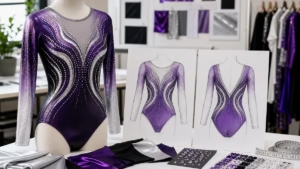
4-Way Stretch and Custom Uniform Design
When you are designing custom cheerleading uniforms, keep these fabric considerations in mind:
Fitting for stretch: Always account for the fabric’s stretch when taking measurements. A uniform designed without stretch consideration will fit too loosely when the fabric relaxes.
Pattern direction: Because 4-way stretch moves in all directions, the pattern pieces should be cut with consideration for how the fabric will behave in each area of the body.
Seam placement: Flatlock seams and strategic seam placement can complement (or conflict with) the fabric’s natural stretch. An experienced manufacturer will optimize seam placement for both aesthetics and performance.
Heat and stretch: Heat-setting (often part of sublimation processing) can affect the stretch recovery of some spandex fibers. Quality manufacturers test this and adjust their processes accordingly.
—
Final Thoughts
If you are ordering custom cheerleading or dance uniforms, insist on 4-way stretch fabric with high recovery. It is not a luxury — it is a performance requirement.
Look for specifications of 80-88% nylon or polyester blended with 12-20% spandex, with a GSM in the 180-220 range. Request a swatch, stretch it in every direction, and check how quickly it recovers.
Your athletes will feel the difference from the first practice.
—
Need a fabric swatch to feel the difference yourself?
—
Word count: ~1,050 | Tags: 4-way stretch, stretch fabric, cheerleading uniform, athletic fabric, flexibilidad, fabric guide