

One of the most exciting parts of getting new cheerleading uniforms is the design process — seeing your team’s personality, school colors, and vision come to life in fabric form. But if you have never designed custom uniforms before, the process can feel overwhelming.
Step 1: Define Your Design Brief
Before you open any design software, start with a clear brief: How many colors? What is the primary element? What is the vibe? Who is the audience? What are the constraints?
Step 2: Choose Your Color Palette
Start with your primary colors: Your school or organization’s main colors. Add accent colors: One or two additional colors for trim, числа, or design accents. Less is more — too many colors dilute the impact.
Step 3: Work with Your Logo and Mascot
Provide a high-resolution vector file (AI, EPS, SVG) — they can be scaled to any size without pixelation. Check the orientation early: Some mascots look great horizontally, others vertically.
Step 4: Choose Your Fonts and Typography
Script fonts: Feminine, elegant, or traditional feel. Block fonts: Bold, readable, authoritative. Athletic/stencil fonts: Aggressive, high-energy. Limit to 2 font styles maximum.
Step 5: Decide on Pattern and Layout
Common uniform layout patterns: Front with school name plus small logo plus number. Back with large mascot plus full team name. Full sublimation with mascot and design flowing across front, back, and side panels continuously.
Step 6: Choose Your Customization Method
Most teams use a combination: sublimation for the body design, screen printing for numbers and names, rhinestones for sparkle.
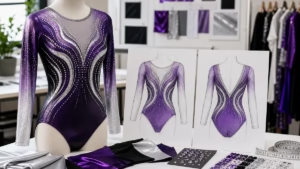
Step 7: Review and Approve the Design Mockup
Before approving the mockup, check all colors match specifications, logo proportions look correct, text is readable and correctly spelled, and no unintended placeholder elements exist.
Step 8: Order a Sample Before Bulk Production
Always request a sample uniform before the full production run. This lets you verify the actual fabric quality, check sublimation color accuracy, confirm fit on different body types, and catch any errors before they are multiplied across 50+ uniforms.