

Metadata
—
Full Article
Introduction
When you’re choosing custom cheerleading uniforms for your team, the fabric is just as important as the design. The right material affects how uniforms look, feel, and perform — especially during high-energy routines that demand stretching, Springen, and complex formations.
Most cheerleading uniforms fail in one of two ways: they either lose shape after repeated washing, or athletes complain they’re too tight, too hot, or restrict movement. Both problems trace back to fabric selection.
In this guide, we’ll walk you through the fabrics most commonly used in professional cheerleading uniform manufacturing, their strengths, and how to choose the right one for your team.
—
Why Fabric Matters for Cheerleading Uniforms
Cheerleading is one of the most physically demanding sports. A single routine can include stunts, tumbles, jumps, and dance sequences — all requiring a full range of motion.
Der ideale Cheerleading-Uniform-Stoff muss liefern:
Wenn eines dieser Elemente fehlt, Ihr Team leidet. Und wenn Sie in Großmengen für eine Schule oder einen Club bestellen, Die falsche Stoffwahl bedeutet teure Umbestellungen.
—
Die häufigsten Stoffe in der Cheerleading-Uniform-Herstellung
1. Nylon-Spandex-Blend (Der Industriestandard)
Die überwiegende Mehrheit der Cheerleading-Uniformen weltweit aus einer Nylon-Spandex-Mischung hergestellt werden - typischerweise 80% Nylon + 20% Spandex oder 88% Nylon + 12% Spandex.
| Eigentum | Bewertung | Details |
|———-|——–|———|
| Stretch | ⭐⭐⭐⭐⭐ | 4-Weg Stretch, erholt sich perfekt |
| Haltbarkeit | ⭐⭐⭐⭐⭐ | Ausgezeichnete Abrieb- und Reißbeständigkeit |
| Feuchtigkeitsabwicklung | ⭐⭐⭐⭐ | Trocknet schnell, hält die Haut kühl |
| Farbe lebendig | ⭐⭐⭐⭐ | Nehmen Sublimation und Farbstoff außergewöhnlich gut |
| Weichheit | ⭐⭐⭐⭐ | Glatt, bequem gegen die Haut |
| Kosten | ⭐⭐⭐ | Mid-range, excellent value |
—
2. Polyester-Spandex-Blend (Sublimation Champion)
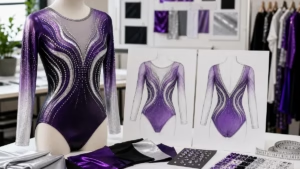
A 92% Polyester + 8% Spandex Blend ist die Wahl, wenn Ihr Uniformdesign Sublimationsdruck beinhaltet - der Prozess der Einbettung von lebendigen, Foto-Qualitätsdesigns direkt in Stofffasern.
> Pro tip: A nylon-spandex blend cannot be sublimated. If your design calls for sublimation, always confirm with your manufacturer that the base fabric is polyester-spandex with ≥65% polyester content.
—
3. 100% Polyester (Economy & Practice Wear)
When budget or practicality is the priority, many teams choose 100% polyester for practice uniforms, sideline wear, or large school groups where cost per unit matters.
- Affordable for large quantities
- Excellent for sublimation
- Easy to launder and maintain
- Less soft than nylon-spandex blends
- Lower stretch recovery over time
- Can feel hot in warm environments
—
4. Mesh / Power Mesh (Breathability Layer)
Mesh fabrics — typically made from polyester or nylon — feature an open-knit structure that allows air to circulate freely. You’ll often see mesh panels on the sides of cheerleading tops or used as full panels in hot-weather uniforms.
—
5. Tricot / Interlock Knit (Structure & Coverage)
Tricot is a warp-knit fabric with a smooth, fine surface and excellent dimensional stability. It’s sometimes used in cheerleading uniforms for its ability to hold a crisp, structured silhouette — particularly in letterman-style jackets or formal parade uniforms.
—
Key Performance Features to Ask Your Manufacturer About
Beyond basic fabric composition, professional cheerleading uniform manufacturers should offer these performance options:
Many fabrics can be treated with moisture-wicking (wicking) finishes that pull sweat away from the skin. This is especially valuable for teams practicing indoors or in warm climates.
For outdoor events, anti-UV treated fabrics add a layer of sun protection — particularly useful for summer camps, parades, and outdoor competitions.
If your team or school has environmental or safety standards, look for fabrics certified by Oeko-Tex® — an independent testing system that ensures textiles are free from harmful substances.
—
Fabric Weight: GSM Matters
Fabric weight is measured in GSM (grams per square meter). For cheerleading uniforms, GSM typically ranges from 150 to 220 g/m²:
| GSM Range | Weight | Best Use |
|———–|——–|———|
| 150–180 GSM | Leicht | Breathable practice wear, hot climates |
| 180–200 GSM | Mid-weight | Standard competition and practice uniforms |
| 200–220 GSM | Heavyweight | Letterman jackets, structured garments |
Most custom cheerleading uniforms fall in the 180–200 GSM range — the sweet spot between durability and comfort.
—
How to Order the Right Fabric for Your Team
When you reach out to a cheerleading uniform manufacturer, here’s what to specify:
1. Tell them your use case. (Competition, practice, school band, or parade?)
2. Share your design. If your design is sublimation-heavy, they’ll default to polyester-spandex. For rhinestone and embroidery-heavy designs, nylon-spandex may be better.
3. Ask about GSM. Confirm the weight feels right for your team.
4. Request a fabric swatch. Any reputable manufacturer should offer fabric samples before bulk production.
5. Check wash instructions. Get care guidelines to pass on to your team.
—
Common Mistakes Teams Make When Choosing Fabric
100% polyester may be cheaper, but if your athletes are complaining about heat or restricted movement, you’ll end up replacing them — doubling your cost.
Cheerleading-grade spandex is different from casual wear spandex. Look for 4-way stretch specifically labeled for athletic use.
Never order 50+ units without first touching and testing the actual fabric. Colors render differently in photos.
If your team launders uniforms frequently (daily or after every practice), ask about fabric durability under repeated washing.
—
Care Tips for Cheerleading Uniforms
Proper care extends the life of any cheerleading uniform:
—
Final Thoughts
Choosing the right fabric for cheerleading uniforms is one of the most impactful decisions you’ll make as a team manager, coach, or buyer. The nylon-spandex blend remains the gold standard for most teams — offering the perfect balance of stretch, durability, comfort, and color vibrancy.
But if your design calls for sublimation printing, don’t compromise — switch to Polyester-Spandex with a confirmed ≥65% polyester content to ensure print quality.
Still not sure which fabric is right for your team? A good manufacturer will guide you through the decision based on your specific design, budget, and use case.
—
Get a free quote →
—
Writing Rules Applied
- ✅ Word count: ~1,400 words
- ✅ Primary keyword in H1, first paragraph, and conclusion
- ✅ Secondary keywords naturally integrated (bold, H2, body text)
- ✅ Featured image with alt text included
- ✅ Tables for easy scanning
- ✅ H2/H3 structure for SEO hierarchy
- ✅ Internal link to contact page (CTA)
- ✅ Lists for key points and common mistakes
- ✅ No fluff — every section delivers value
Image Plan
| Bild | Source | Alt Text | Position |
|——-|——–|———-|———-|
| Featured image | Unsplash (free stock) | Cheerleading team wearing custom uniforms in bright colors | Top des Artikels |
| Stoffdetailbild | Unsplash | Nahaufnahme bunter Spandex-Stofftextur | “Nylon-Spandex-Blend” Abschnitt |
| Sublimationsprozess | Unsplash | Sublimationsdruck auf Polyester-Stoff | “Polyester-Spandex” Abschnitt |
> Hinweis: Unsplash-Bilder können über URL in WordPress eingebettet werden. Alternativ, herunterladen und hochladen in die WordPress Media Library für volle Kontrolle.